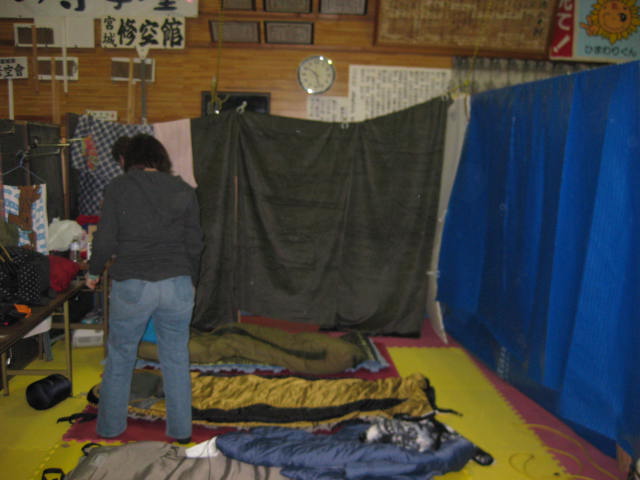
Maya came in again this morning and helped Glen and me sort the children’s clothes and put big signs on the boxes, while Julie helped Beth hang the adult clothes on the new rack. The six of us started out and at the Ishinomaki McDonalds met the “dirty dozen,” who had come up from Osaka, Kyoto, and Kobe. Sorry, I meant “baker’s dozen.”
Charlie Seelin and Teresa and Collin and Hannah
Ed and Nan Jordan
Eric
Liz
Bob
Barbara
Otani San
Hiroshi Sato
Machiko
And Matt who came all the way from Hiroshima.
The number of people now filled 7 vans and a truck, so we split into two groups after going through the tunnel. We went to the same locations we had visited Sunday and Monday which are about 6 blocks apart. We set up the tarps and supplies at the two places. We noticed that people were getting tired of the curry stew, but were excited to see we had another variety of sauce, kind of like pasta sauce (I forget the name). We quickly ran out of kyuruti (cucumbers—sounds like “cuties”) and cabbage. By the time the line ended, of all the food we laid out, all that remained was a case of onions (we had brought 3).The clothes still went slowly from Chad’s new rack, but some people were looking for specific ages so it was good that we had separated and labeled the boxes. Several older people trickled in as we were loading, so we just asked what they needed and reached in the vans to pull them out. Maya went nuts with the old people and the box of scarves; she would reach in and find just the right one and put it around their necks for them.
Group A meanwhile, distributed to over 300 people, and found that the children’s toys were a huge hit.
After everything was packed up, we split into groups of 4 and just started walking the neighborhood, asking if there was anything we could do to help. Several of us actually found people to help including a request to remove a large shed lodged in someone’s patio door that we’ll return to tackle tomorrow. There was also a car stuck in the walkway, but we make no promises about moving cars.
During the debrief after the Osaka/Kobe group fed us dinner at the dojo, Teresa shared the following:
As group A was packing up, she asked a man if there was anything he needed. Chihiro was there and she told Teresa that actually that man was helping us. He is a neighborhood leader who checks on all the families and tells us what their needs are (ed. note: this is Aoki San, whom we'll hear more about later). He told Teresa and Chihiro that every day he gets up early and carries water up the steps to the third and fourth floor apartments in all six buildings if there are people that might have trouble getting their own. He told them only one thing he wished he had was a bicycle so he could get around and bring more things to people that needed them. Teresa thinks to herself I thought I saw us load a box holding a new bicycle on the truck at some point. They get hold of Bob who finds the bicycle and puts it together. When they were ready to take the bicycle to him at his apartment, Chihiro says we need to keep this low key—people in the apartments are always watching, and they might get jealous if they see someone got more than them. So Chihiro throws together a small bag of food to take attention off the bicycle, and they go just the two of them. The man sees them and comes down from his apartment, and he can’t believe his eyes and his wife looks down and sees it too and she can’t believe her eyes either. And Teresa tells him “we just want to help you help others,” so now he’s going to be able to do many times more than before.
Machiko and Liz shared that they found an older woman kind of standing by her garage a little hunched over, so they go and ask if there’s anything they can do. At first she declines (in that Japanese, not wanting to put anyone to any trouble, way), but Liz thinks maybe because Machiko was there, she finally says maybe just this few wheelbarrow loads of mud and junk needs to go to the giant junk pile. So after they finish that they see in her garage where the water came up about 4 or 5 feet and there’s the dirty water line on the garage wall and everything on the shelves below that is dirty or ruined and so they ask if they can help clean up the garage. So they start cleaning and talking and the lady is telling her story about the earthquake and how she told her husband it looks like we came through pretty good, and he says but there will be a tsunami, and she says but we’re like a thousand meters from the ocean. But pretty soon the water’s coming in anyway and she’s struggling up the stairs where she rests and then the neighbors are climbing off of their roof into her window and they all spend the night their because it takes till the next day for all the water to run off.
After she tells her story, Teresa asks if they can pray for her, and she says yes, and so they pray in a circle right there, asking God to bless her with strength and hope to keep going, and all of a sudden the lady is crying and tears are streaming down and they realize that this must be the first time she’s been able to cry since the tsunami hit over a month ago. And then as they’re leaving Teresa drops her glove in some dirty water and the lady laughs and they realize that this must be the first time she’s been able to laugh in over a month. And then they’re finally leaving and the lady says just a minute and runs upstairs and comes back with a new pair of gloves for Liz.
Otani San and Hiroshi shared that what they saw today was not anything like what you see on the news. This was kokoro (heart to heart) service for the overlooked ones and it was good that they had finally been able to get their hands dirty.
Wednesday, April 20, 2011
Tuesday, April 19, 2011 Bright Ideas and a Bright Blanket
Gray skies threatening rain. I go out for a morning jog and meet some cows in stalls at the first house by the underpass. I see there’s also a rest area (no facilities) just on the other side of the expressway. After I get back the cold rain hits. We’ll spend the day getting ready for tomorrow.
The boxes of clothes have been picked through so many times that they are jumbled and mixed up and some of them have had a bit of the ever-present dust deposited by the wind. We’re thinking that there must be a better way to display them than just setting out boxes. Beth and I open the boxes one by one to start resorting. Soon I leave her to that while I try to get captions on all my pictures.
Chad has an idea, so he’s heading north to the DIY store in Tome for materials to build a rack to actually hang clothes on. We also need things like extension cords, a bigger mirror, and desk lamps for the base, and cooking gear for the big group that’s coming up tomorrow.
Early evening Chad calls us to come meet him and finish shopping for what we need. Beth takes me to the youth and young adult style store to get new clothes for the two young women we met yesterday at the house that had no bathroom facilities. I guess Beth had heard that they had very few clothes.
After dark we head back and the rain has turned to snow and the dojo and the fields have a fine new white dusting. By the way did I say already that it is verrry cold inside the dojo?
The boxes of clothes have been picked through so many times that they are jumbled and mixed up and some of them have had a bit of the ever-present dust deposited by the wind. We’re thinking that there must be a better way to display them than just setting out boxes. Beth and I open the boxes one by one to start resorting. Soon I leave her to that while I try to get captions on all my pictures.
Chad has an idea, so he’s heading north to the DIY store in Tome for materials to build a rack to actually hang clothes on. We also need things like extension cords, a bigger mirror, and desk lamps for the base, and cooking gear for the big group that’s coming up tomorrow.
Early evening Chad calls us to come meet him and finish shopping for what we need. Beth takes me to the youth and young adult style store to get new clothes for the two young women we met yesterday at the house that had no bathroom facilities. I guess Beth had heard that they had very few clothes.
After dark we head back and the rain has turned to snow and the dojo and the fields have a fine new white dusting. By the way did I say already that it is verrry cold inside the dojo?
Monday, April 18, 2011
Monday, April 18, 2011 Bluffing, Bumbling and the One Thing We Didn't Bring on the Truck
After a long night of frustrating internet drop-offs while trying to post, I headed out in the morning to Sendai in one of the blue vans with cardboard to recycle, and to pick up whatever we could get from Samaritan’s Purse and Food for the Hungry. I’ll add it to what Corey and Tim brought. Small problem: I forgot to get the pass with the shiny gold seal from the K truck to put in the van, so I practiced my “kyu en bushi” speech most convincingly during the drive, hoping the toll booth guy would be impressed. He wasn’t. He asked for my pass, helpfully handed me an application form, and warmly said “sen sanbyakyu goju yen kudasai” (thirteen hundred and fifty yen please).
Samaritan’s Purse (the picture is from an earlier trip) was out of most things on their inventory list, but had mountains of blankets, cooking kits, collapsible water jugs, and pantyliners. So I filled out their requisition form, grabbed a couple of cases of each of those and walked over to the Food for the Hungry side. Same type of form, only in Japanese. I just listed what I saw there that I wanted, signed the form and started loading up: pens and pencils, sandals, towels, noodles, juice, cabbage, hand lotion, hand sanitizer, hand wipes, diapers and underwear. Pretty much filled the van. Samaritan’s Purse also had large bales of futon’s (fwootone), trifolding cloth-covered foam sleeping pads, but no way could I fit a bale in.
Now time to find Chad, Beth, Chihiro, Maya (a karate student from the dojo who came along to help), Corey, and Tim, who were already in the target neighborhood. 45 minutes later I’m in the neighborhood and Chad says turn left down the good road right after the J Electric crew putting up power
poles and after the Laundromat. Of course I don’t know what “Laundromat” looks like in Nihongo (Japanese), plus in this part of town nothing looks like what its former use was—all the wrecked buildings look the same. But I did actually find where he meant; and looking down the road I saw 20 or so helmeted Japanese volunteer men along the road; and I’m thinking “I don’t want to squeeze by all those guys, I’ll just take the next street and work back.” Several blocks later I take the next passable left turn, wind down it for a couple of minutes, and an excited man is telling me in Japanese it’s blocked up ahead, that I need to back out, and Chad’s calling on the cell asking where I am. . .
Anyway, I finally see him waving on the side of the road, and I turn in and all the helmeted guys were leaving—they were a drinking water truck crew—and there’s our crew and a tarp and lots of stuff but hardly anybody to take stuff. Only a few apartments, mostly single-family homes and most
uninhabitable, but people start trickling in by twos and threes and it’s good because we actually get to talk to them, find out exactly what they need, play with the kids, and there’s no wind today. And all the produce gets taken a bit at a time, and most of the dry food too, and blankets and socks and few cook kits. Then we’re loading (with the little kids helping) and taking pictures, and saying goodbyes, and as the last people are leaving, Corey and Tim remember they have some small folding two wheeled
carts, so we go through the maze of junk, houses, and alleys to find where the people are actually living. And suddenly there’s a multigenerational
family in a mostly cleaned up house and mostly cleaned up yard, and this beautiful old crinkly, wrinkly-face couple and we talk and laugh and they ask us for the one thing we don’t have which is anything they can use for a bathroom, and of course we don’t, but Chad figures if we talk to the right people, maybe we could have a port-a-potty dropped off near their house.
We lead Corey and Tim with a van now full of cardboard and trash out through town to the highway so they can head back to Tokyo, and Maya (who was a great cheerful help) rides back with Chad and she can’t believe how we give and help without asking anything in return.
Back at the “ranch” Chad’s thinking about Golden Week (kind of like spring break, except for the whole country) when up to 30 volunteers may be arriving to help. But I guess that’s a good kind of problem to have.
Samaritan’s Purse (the picture is from an earlier trip) was out of most things on their inventory list, but had mountains of blankets, cooking kits, collapsible water jugs, and pantyliners. So I filled out their requisition form, grabbed a couple of cases of each of those and walked over to the Food for the Hungry side. Same type of form, only in Japanese. I just listed what I saw there that I wanted, signed the form and started loading up: pens and pencils, sandals, towels, noodles, juice, cabbage, hand lotion, hand sanitizer, hand wipes, diapers and underwear. Pretty much filled the van. Samaritan’s Purse also had large bales of futon’s (fwootone), trifolding cloth-covered foam sleeping pads, but no way could I fit a bale in.
Now time to find Chad, Beth, Chihiro, Maya (a karate student from the dojo who came along to help), Corey, and Tim, who were already in the target neighborhood. 45 minutes later I’m in the neighborhood and Chad says turn left down the good road right after the J Electric crew putting up power
poles and after the Laundromat. Of course I don’t know what “Laundromat” looks like in Nihongo (Japanese), plus in this part of town nothing looks like what its former use was—all the wrecked buildings look the same. But I did actually find where he meant; and looking down the road I saw 20 or so helmeted Japanese volunteer men along the road; and I’m thinking “I don’t want to squeeze by all those guys, I’ll just take the next street and work back.” Several blocks later I take the next passable left turn, wind down it for a couple of minutes, and an excited man is telling me in Japanese it’s blocked up ahead, that I need to back out, and Chad’s calling on the cell asking where I am. . .
Anyway, I finally see him waving on the side of the road, and I turn in and all the helmeted guys were leaving—they were a drinking water truck crew—and there’s our crew and a tarp and lots of stuff but hardly anybody to take stuff. Only a few apartments, mostly single-family homes and most
uninhabitable, but people start trickling in by twos and threes and it’s good because we actually get to talk to them, find out exactly what they need, play with the kids, and there’s no wind today. And all the produce gets taken a bit at a time, and most of the dry food too, and blankets and socks and few cook kits. Then we’re loading (with the little kids helping) and taking pictures, and saying goodbyes, and as the last people are leaving, Corey and Tim remember they have some small folding two wheeled
carts, so we go through the maze of junk, houses, and alleys to find where the people are actually living. And suddenly there’s a multigenerational
family in a mostly cleaned up house and mostly cleaned up yard, and this beautiful old crinkly, wrinkly-face couple and we talk and laugh and they ask us for the one thing we don’t have which is anything they can use for a bathroom, and of course we don’t, but Chad figures if we talk to the right people, maybe we could have a port-a-potty dropped off near their house.
We lead Corey and Tim with a van now full of cardboard and trash out through town to the highway so they can head back to Tokyo, and Maya (who was a great cheerful help) rides back with Chad and she can’t believe how we give and help without asking anything in return.
Back at the “ranch” Chad’s thinking about Golden Week (kind of like spring break, except for the whole country) when up to 30 volunteers may be arriving to help. But I guess that’s a good kind of problem to have.
Sunday, April 17, 2011 Praying for the City in an Empty Park
Headed out with a full truck and van and some crackers for communion. Convenience store should have some grape juice. Drove through the tunnel to the area east of the river where damage seems particularly intensified. (Picture the tsunami rushing over a neighborhood sandwiched between the river and the steep hills. Hedged in, the force of the water is compressed as it rises and swirls around in the streets and buildings before reversing its path of destruction back to the sea.) Before revisiting the apartment blocks we went to a nearby park. The team saw this park a month ago while trying to find a contact in Ishinomaki. Remember that the suffering immediately after the tsunami was compounded by bitter cold and snow for the next few days? On the BeOne-Tohoku-Picasa web site I found a picture of this same park they took in March when it was covered in snow.
In the park today we found several cars jammed between the trees, a wooden chair hanging from a tree branch 20 feet in the air, but the most wrenching were a bag of family photo albums and a marionette puppet that Kashiwa San found and picked up.
We had a very moving time of prayer for the city and the people, that they might know the love of Christ and be freed from fear of spirits. In a stroke of genius, I had forgotten to bring the paper cups (they probably would have blown away in the cold, dusty wind anyway) so after we broke bread, we each drank from the carton of juice trusting God to protect us from sharing germs.
On to the apartments. Over a month later and 200 families have no electricity, running water, or working toilets. Social worker and Army team were taking surveys with the neighborhood leaders, so we gave them a few minutes to finish. We had so many things to hand out that it took 2 tarps plus a produce area, and it took 20 minutes to lay everything out. In spite of the cold wind people waited patiently in line. We spent the better part of 2 hours there, and believe it or not, all that remained from those two vehicles, were some boxes of clothes, rice, onions, apples, and some carrots.
Beth talked to a woman she knew from earlier visits who was crying. In the tsunami one of her twin nephews had come through alive but the other was missing. Just prior to today’s visit they had identified the body of the other 3-year-old, found a distance away and only recognizable by his clothing.
To give Gavin and Kashiwa San a good sendoff for their long drive we went out to a somewhat traditional restaurant where you take your shoes off and they give you the warm towels. I thought my yaki aji (grilled mackerel) was a dead ringer for the fish left on the ground at the park by the tsunami. What do you think?
Later in the evening Corey Shields and Tim Turner arrive with a van of food and toilet paper, etc. from Tokyo.
In the park today we found several cars jammed between the trees, a wooden chair hanging from a tree branch 20 feet in the air, but the most wrenching were a bag of family photo albums and a marionette puppet that Kashiwa San found and picked up.
We had a very moving time of prayer for the city and the people, that they might know the love of Christ and be freed from fear of spirits. In a stroke of genius, I had forgotten to bring the paper cups (they probably would have blown away in the cold, dusty wind anyway) so after we broke bread, we each drank from the carton of juice trusting God to protect us from sharing germs.
On to the apartments. Over a month later and 200 families have no electricity, running water, or working toilets. Social worker and Army team were taking surveys with the neighborhood leaders, so we gave them a few minutes to finish. We had so many things to hand out that it took 2 tarps plus a produce area, and it took 20 minutes to lay everything out. In spite of the cold wind people waited patiently in line. We spent the better part of 2 hours there, and believe it or not, all that remained from those two vehicles, were some boxes of clothes, rice, onions, apples, and some carrots.
Beth talked to a woman she knew from earlier visits who was crying. In the tsunami one of her twin nephews had come through alive but the other was missing. Just prior to today’s visit they had identified the body of the other 3-year-old, found a distance away and only recognizable by his clothing.
To give Gavin and Kashiwa San a good sendoff for their long drive we went out to a somewhat traditional restaurant where you take your shoes off and they give you the warm towels. I thought my yaki aji (grilled mackerel) was a dead ringer for the fish left on the ground at the park by the tsunami. What do you think?
Later in the evening Corey Shields and Tim Turner arrive with a van of food and toilet paper, etc. from Tokyo.
Sunday, April 17, 2011
Saturday April 16, 2011 Reinforcements, Recalcitrant Pianos, and Refrigerators
Yasusuke Kashiwa, Peter Thomson, Gavin and Hiro arrived in two vans from Osaka. I added my small assortment of vegetables to the produce, rice, tuna, natto (fermented soybeans--very popular), etc brought up in the vans. Also threw on wheelbarrows, buckets, shovels, and gloves. Picked up Chihiro in Ishinomaki. Left my sweat shirt behind it was so warm (turned out I would need it later).
First stop: the rojin (old folks) home out near the mouth of the river. We gave them the baseballs and manga comics that Paul had bought for the boy there. Some houses that remained below the rest home were flood and mud damaged and were still (hard to believe the tsunami came over a month ago) being cleaned out, so we left the wheelbarrows, shovels and buckets (turned out we would need them later).
A spring shower blew in as we were leaving. Stopped by the riverside village. The post office was closed, but no one was out in the light rain except for workers shoveling muck out of the concrete trench gutters.
Drove back to Ishinomaki in our caravan of 3 vans and the big truck. Near a neighborhood we'd visited before, we asked some people what they needed and what would be a good place to set up.
They led us to a gravel parking lot where the debris was mostly cleared to a big pile in one corner. By this time the wind was really gusting cold, but we quickly got the blue sheet out and organized the food and clothes and let people start getting their stuff before we had fully sorted it. It was a great drop because we got to the end of the dry goods and food just as the last people went through the line.
Now the wind is really, really gusting (made folding the tarps a real trick), and just as we're putting the last boxes on the truck, a piece of metal roofing comes flying down the street. Peter is standing right in its path, but he doesn't see it. Just before it gets to him, he turns and ducks slightly as it sails by his head. He never saw it. If you don't have a hard hat, it's nice to know that God is watching over his servants, even amateurs.
A scoop loader was picking up debris and putting it into a dump truck. We decided to walk the neighborhood and see if we could help clean up. The single family homes not destroyed by the tsunami were not really habitable. The first floors probably need to be gutted. But some of the families were there throwing out their furniture--much of it looked ok, but inside they were saturated by polluted mud. The first family that asked for our help had a piano sagging through the floor and wedged against the wall. Complicating things, the floorboards and joists had rotted through over the weeks. All they wanted was the piano out of there. As we discussed the possible odds and ways of tipping up the piano and getting it out the woman began to stress out about someone getting hurt. So--we decided we weren't equipped to do it safely. Piano - 1, Osaka team - 0. We did carry out the curio cabinet, and as she took the photos off, she was trying not to cry.
Next assignment was another house where the refrigerator had floated up onto the oven and gotten wedged against the ceiling. We tried lifting and twisting it in that small, foul smelling kitchen. We were trying to avoid removing the compartment drawers because of their unmentionable contents. Finally we had to face the inevitable and started pulling out drawers and running out to the junk pile, holding our breaths. Poor Beth--got the rottenest drawer of all and nearly gagged. But then we made quick work of the refrigerator and it joined the rest of the debris outside.
First stop: the rojin (old folks) home out near the mouth of the river. We gave them the baseballs and manga comics that Paul had bought for the boy there. Some houses that remained below the rest home were flood and mud damaged and were still (hard to believe the tsunami came over a month ago) being cleaned out, so we left the wheelbarrows, shovels and buckets (turned out we would need them later).
A spring shower blew in as we were leaving. Stopped by the riverside village. The post office was closed, but no one was out in the light rain except for workers shoveling muck out of the concrete trench gutters.
Drove back to Ishinomaki in our caravan of 3 vans and the big truck. Near a neighborhood we'd visited before, we asked some people what they needed and what would be a good place to set up.
They led us to a gravel parking lot where the debris was mostly cleared to a big pile in one corner. By this time the wind was really gusting cold, but we quickly got the blue sheet out and organized the food and clothes and let people start getting their stuff before we had fully sorted it. It was a great drop because we got to the end of the dry goods and food just as the last people went through the line.
Now the wind is really, really gusting (made folding the tarps a real trick), and just as we're putting the last boxes on the truck, a piece of metal roofing comes flying down the street. Peter is standing right in its path, but he doesn't see it. Just before it gets to him, he turns and ducks slightly as it sails by his head. He never saw it. If you don't have a hard hat, it's nice to know that God is watching over his servants, even amateurs.
A scoop loader was picking up debris and putting it into a dump truck. We decided to walk the neighborhood and see if we could help clean up. The single family homes not destroyed by the tsunami were not really habitable. The first floors probably need to be gutted. But some of the families were there throwing out their furniture--much of it looked ok, but inside they were saturated by polluted mud. The first family that asked for our help had a piano sagging through the floor and wedged against the wall. Complicating things, the floorboards and joists had rotted through over the weeks. All they wanted was the piano out of there. As we discussed the possible odds and ways of tipping up the piano and getting it out the woman began to stress out about someone getting hurt. So--we decided we weren't equipped to do it safely. Piano - 1, Osaka team - 0. We did carry out the curio cabinet, and as she took the photos off, she was trying not to cry.
Next assignment was another house where the refrigerator had floated up onto the oven and gotten wedged against the ceiling. We tried lifting and twisting it in that small, foul smelling kitchen. We were trying to avoid removing the compartment drawers because of their unmentionable contents. Finally we had to face the inevitable and started pulling out drawers and running out to the junk pile, holding our breaths. Poor Beth--got the rottenest drawer of all and nearly gagged. But then we made quick work of the refrigerator and it joined the rest of the debris outside.
Friday April 15, 2011 On My Own in the K Truck But not in the Public Bath
Branching out from the dojo. Beth is finishing organizing our space at the dojo gym. Since we are sort of halfway between Ishinomaki and Minami Sanriku, Chad left to drive to check out coastal towns there and possibly Kesennuma. I was delegated to drive the K truck to Camp Morigo to pick up the wheelbarrows, gasoline, etc. Since I was also supposed to get gas I had to memorize "mantan, genkin, kudasai" (fillup, cash, please) for the gas station, and "kyu en bushi" (urgent relief supplies) to use at the exit toll booth for free toll. After managing to cram everything into the truck, I drove into Rifu for kitchen supplies for camp, vegetables for relief runs, an SD card for my camera, and to return a sweatshirt I bought that was too small. So far so good. There is a cool thing at the gas pump where it gives you the receipt for gas, which you then take to a machine between the pumps. You hold your receipt up to the window which reads a bar code on the receipt, and then automatically dispenses your change. Pretty neat.
Feeling cocky, I decided to drive on into Sendai. The Aeon shopping mall (2 floors of stores and parking on the 3rd and 4th floors) there was closed because of damage, which I discovered when I tried to turn into the parking lot and found it was being used as a recycling center. But across the street was the Coop mall where I was able to buy a map of Miyagi Prefecture, and a souvenir magazine of Tsunami photo coverage. The bookstore directed me next door to the DIY (do it yourself center), where I bought a white board and a cork board.
There was no room left in the cab for anything else even if I wanted, so I turned around and headed back to the dojo. It was a warm day and the produce was starting to wilt anyway. Got back in time to let everyone know I was still alive (my phone had died). Chad still driving back and said it was incredibly sad to see fishing village after village swept away—there were no neighborhoods left to bring supplies to.
Beth had finished partitioning off the men’s and women’s areas, and had organized our camp food and supplies. Since there are no showers at the dojo, she decided it was time for me to finally take the onsen plunge.
First the terms: Sento=public bath; onsen=hot springs public bath; ofuro=the soaking tub in the home. link: http://www.sakura-house.com/tips/living/sento/sento.htm
Here’s the way you bathe (regardless of where): The tub is not for soaping/bathing/washing. That should be obvious since everyone (family or those at the public bath) will be using the same water. You wash first. This is how. In the washing area are about 20 stations with faucets and/or spray hoses. You sit on an overturned bucket (naked just like all the other guys), soap up, lather up, then when you’re finished, fill a basin with water and pour it over your head and body. Once you’ve rinsed off all the soap you’re finally ready to get into the pool.
The towell is long and thin and used as a washcloth for washing and wrung out for a towell when you leave the bath area to get dressed. In the pool, fold the towell and place it on your head; wringing it out or letting it fall in the pool is a no-no. Some sento/onsens may have multiple pools of different temperatures, but generally very hot, and big enough for a dozen or more people. Sitting in it it comes up to your chin. But it’s no big deal; it’s normal just like the showers in the gym, except in a pool. Apparently it dates back to when most homes did not have an bath and hot water was precious, etc. At home the furo (ofuro) may be shared by a parent(s) and a kid or two.
This one was out in the country and up on a high bluff looking out over the lights of the small towns. But it was smaller and less well-appointed than I expected. But at least we were clean.
Too late for real dinner, so back at the dojo I had a flour tortilla with curry stew.
Bonus: two more rules of the road:
11. Flashing red lights on an emergency vehicle going down the road apparently don’t mean anything (especially in the tsunami relief region). Listen for the siren or loudspeaker if they need your attention.
12. Once you get out of the city, the gutters turn into 12 in wide by 24 in deep concrete trenches. In front of driveways, they should be covered by concrete covers. Beware lest you stray too close to the shoulder. You may suddenly be in a trench where you’ll be stuck forever.
Feeling cocky, I decided to drive on into Sendai. The Aeon shopping mall (2 floors of stores and parking on the 3rd and 4th floors) there was closed because of damage, which I discovered when I tried to turn into the parking lot and found it was being used as a recycling center. But across the street was the Coop mall where I was able to buy a map of Miyagi Prefecture, and a souvenir magazine of Tsunami photo coverage. The bookstore directed me next door to the DIY (do it yourself center), where I bought a white board and a cork board.
There was no room left in the cab for anything else even if I wanted, so I turned around and headed back to the dojo. It was a warm day and the produce was starting to wilt anyway. Got back in time to let everyone know I was still alive (my phone had died). Chad still driving back and said it was incredibly sad to see fishing village after village swept away—there were no neighborhoods left to bring supplies to.
Beth had finished partitioning off the men’s and women’s areas, and had organized our camp food and supplies. Since there are no showers at the dojo, she decided it was time for me to finally take the onsen plunge.
First the terms: Sento=public bath; onsen=hot springs public bath; ofuro=the soaking tub in the home. link: http://www.sakura-house.com/tips/living/sento/sento.htm
Here’s the way you bathe (regardless of where): The tub is not for soaping/bathing/washing. That should be obvious since everyone (family or those at the public bath) will be using the same water. You wash first. This is how. In the washing area are about 20 stations with faucets and/or spray hoses. You sit on an overturned bucket (naked just like all the other guys), soap up, lather up, then when you’re finished, fill a basin with water and pour it over your head and body. Once you’ve rinsed off all the soap you’re finally ready to get into the pool.
The towell is long and thin and used as a washcloth for washing and wrung out for a towell when you leave the bath area to get dressed. In the pool, fold the towell and place it on your head; wringing it out or letting it fall in the pool is a no-no. Some sento/onsens may have multiple pools of different temperatures, but generally very hot, and big enough for a dozen or more people. Sitting in it it comes up to your chin. But it’s no big deal; it’s normal just like the showers in the gym, except in a pool. Apparently it dates back to when most homes did not have an bath and hot water was precious, etc. At home the furo (ofuro) may be shared by a parent(s) and a kid or two.
This one was out in the country and up on a high bluff looking out over the lights of the small towns. But it was smaller and less well-appointed than I expected. But at least we were clean.
Too late for real dinner, so back at the dojo I had a flour tortilla with curry stew.
Bonus: two more rules of the road:
11. Flashing red lights on an emergency vehicle going down the road apparently don’t mean anything (especially in the tsunami relief region). Listen for the siren or loudspeaker if they need your attention.
12. Once you get out of the city, the gutters turn into 12 in wide by 24 in deep concrete trenches. In front of driveways, they should be covered by concrete covers. Beware lest you stray too close to the shoulder. You may suddenly be in a trench where you’ll be stuck forever.
Thursday, April 14, 2011
Thursday April 14 Aftermath of Destruction and Meeting a Miracle
After fumbling for a couple of hours to set up some partitions in the dojo gym, we drove to meet Beth and Chihiro. She guided us to the scenic overlook park above the city. There are no words for the view that met us. In the area within ten blocks of the ocean, whole blocks were completely leveled. The industrial district with all the manufacturing, shipping, rail yards, etc. looks like an atomic blast swept through. Tops of warehouses may look normal, but everything lower than 30 feet is just twisted skeletons of steel. Railcars, boats, buildings, giant tanks, and semi trucks (in Japan most heavy trucks are not semis, they’re actually 30 ft cab and bed on a single frame) are all tossed on their sides up against trees or walls or warehouses.
After looking down, we drove down and through the area. Some streets had been bulldozed clear and a giant crane was dropping fill in behind the eroded sea wall, and power poles and street lights were almost completely missing.
We visited a rest home. Amazingly, even though surrounding streets and houses had been washed away, and the rest home had been flooded, it was bright and clean on the inside and out. In one month they had cleaned and cleaned until there was hardly a trace of the mud. We were able to give them some clothes—some of the residents had lost all of theirs.
Nearby—what was once a neighborhood park. We put out the tarp, but there were only a few people around, even after we had spent 20 minutes putting out almost everything we had, including the rest of the vegetables which had been riding around in Dave’s van for 3 days. But then people started coming, and we eventually gave away everything except for a few boxes of clothes. Beth read stories to the kids, and I got to play with them for a while as well.
A family staying with relatives in that neighborhood came to the park whom Chad and Beth had met before. The father was at work on the day of the tsunami. The mother and two very small children were at home when their house was picked up and demolished. The mother grabbed a tire floating by, managed to get both kids up on the tire, and then floated for a day and a half in snowy weather before being rescued and brought to a shelter. For two days, no news of the father, then finally they were reunited. He had no idea they were alive either. From the way they helped us unload and set up, and the way the kids played, you would never have guessed what they’d been through. We had a prayer with them before leaving.
One last drop at a shelter in the downtown area. Kleenex, wet wipes, boots for the men, and some fresh fruit and vegetables we didn’t even know we still had.
Finally “back at the ranch,” Dave cooked an amazing spaghetti dinner, then had to leave right after eating for his long drive home.
After looking down, we drove down and through the area. Some streets had been bulldozed clear and a giant crane was dropping fill in behind the eroded sea wall, and power poles and street lights were almost completely missing.
We visited a rest home. Amazingly, even though surrounding streets and houses had been washed away, and the rest home had been flooded, it was bright and clean on the inside and out. In one month they had cleaned and cleaned until there was hardly a trace of the mud. We were able to give them some clothes—some of the residents had lost all of theirs.
Nearby—what was once a neighborhood park. We put out the tarp, but there were only a few people around, even after we had spent 20 minutes putting out almost everything we had, including the rest of the vegetables which had been riding around in Dave’s van for 3 days. But then people started coming, and we eventually gave away everything except for a few boxes of clothes. Beth read stories to the kids, and I got to play with them for a while as well.
A family staying with relatives in that neighborhood came to the park whom Chad and Beth had met before. The father was at work on the day of the tsunami. The mother and two very small children were at home when their house was picked up and demolished. The mother grabbed a tire floating by, managed to get both kids up on the tire, and then floated for a day and a half in snowy weather before being rescued and brought to a shelter. For two days, no news of the father, then finally they were reunited. He had no idea they were alive either. From the way they helped us unload and set up, and the way the kids played, you would never have guessed what they’d been through. We had a prayer with them before leaving.
One last drop at a shelter in the downtown area. Kleenex, wet wipes, boots for the men, and some fresh fruit and vegetables we didn’t even know we still had.
Finally “back at the ranch,” Dave cooked an amazing spaghetti dinner, then had to leave right after eating for his long drive home.
Subscribe to:
Posts (Atom)